
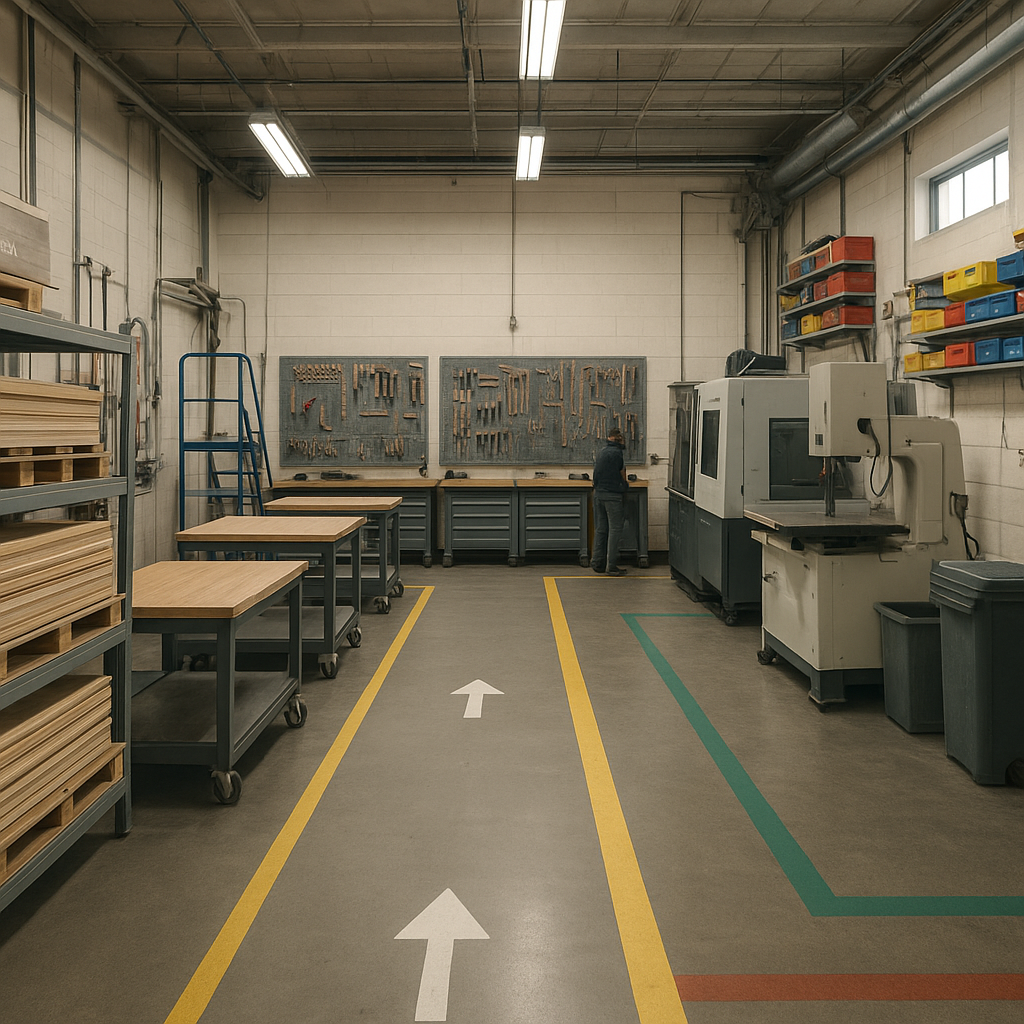
One limitation that defines a small commercial workshop is everything else: square footage. Any inch taken up by junk, clunky traffic patterns, or misplaced tools is an inch that can’t produce income. The space between a shop that hums and one that never stops grinding up against itself is typically not the equipment, but how the space works around the equipment.
Start with layout geometry
Before you even look at a storage unit, figure out how product and materials move through your warehouse physically. Everything should come in, get worked on and go out. If one of the legs between these three points doubles back on another, you’re wasting energy and time moving things in and out of storage. A U-shaped layout is very elegant since material comes in one leg of the U, is cut, shaped, assembled, etc. at the head, and product goes out the other leg. Nothing doubles back. For a narrower layout, a single leg with all the stations side by side works the same way. Figure this out and make any changes on paper first: two or three strategic pieces of bulldozer time may be all you need to get rid of 75% of the drag.
Getting storage off the floor
You should not keep valuable floor space in a small commercial workshop occupied with anything that doesn’t have to be there – and the ceiling is almost certainly underutilized.
Bulk materials, hardware stock, and bins all find their home on wall-mounted shelving. The same shelving can serve as an easy way to keep materials off the floor but within easy reach. Overhead storage will often provide additional utility, such as a place to bundle and store short lengths of frequently used suspension rod or unistrut.
Install overhead utility drops for air, power, or even network cabling. Running these from the ceiling to your workstations eliminates two of the most common tripping hazards in a workshop and also helps keep the floorspace and benchtop free of cables, hoses, or extension cords. Better still, technicians are no longer forced to route air or power across the floor from overhead booms or reels and can move freely between stations.
For valuable hand tools and equipment, there is simply no substitute for lockable metal cabinets – particularly in a commercial setting. The shop air is shot through with grinding dust and machining debris, and moisture levels that can damage sensitive equipment over time. Cabinets protect against all three, all while also controlling access to inventory. Sourcing from https://www.metalcabinetstore.com/ gets you the load ratings and locking hardware that commercial use actually demands – residential grade storage won’t hold up to the weight cycles or the environment.
The 5S system applied to a commercial setting
5S – Sort, Set in Order, Shine, Standardize, Sustain – is often mistaken for a housekeeping technique. Nonetheless, it is a structured approach to minimize the time it takes for a technician to get a tool he needs.
You begin by pulling everything out of storage and being merciless about what to keep. Bench or wall for daily use. Cabinets for a monthly one. Consolidate or get rid of anything you rarely use. On its own, the first step usually frees up a surprising amount of space.
Then you need shadow boards. These boards with outlines of where each tool belongs allow you to tell instantly, without asking anyone, if a tool is missing. Just “Set in Order” over and over. Return times no longer go undetected, and end-of-day meltdowns don’t happen.
Systematic workplace organization from lean methods such as 5S has been estimated to yield productivity improvements of 10% to 30%. For a small business, that is not an insignificant increase, it’s just a few hours of labor every week.
Mobile workstations change how you use the space
A fixed layout is optimized for one type of job. Most small shops don’t do one type of job.
By mounting secondary workbenches, assembly tables, and scrap bins on heavy-duty locking casters, your floor plan can change in under ten minutes. A large fabrication project might need the center of the shop open. A smaller finishing run might need two benches pulled together. Casters make that possible without anyone committing to a permanent reconfiguration.
The key word is locking. A workstation that drifts during use creates an ergonomics problem and a safety hazard. Quality casters lock hard enough that the bench doesn’t move under load, then release quickly when you actually need to move it.
Ergonomics and clearance paths
Being efficient isn’t just about storage and layout. When a bench is too high or too low for the technician working there, they tire faster, make more mistakes and take more of those
small breaks that doom your throughput. Adjustable-height benches or purpose-built stations, matched to work type and worker height, can significantly cut down on both physical strain and timing losses.
Pathways and clearance are no different and in some ways, even more important. An aisle that can’t be walked, for whatever reason, is a major obstacle in your daily work process and you just have to go around it – dozens of wasted motions. Until you are compliant with current safety standards for a clear aisle, we can’t talk about ‘nice-to-haves’.
In a very real sense, a small commercial workshop can’t absorb and isolate wasted motions the way a larger operation can. Every lost hour looking for something is an hour of production that’s just gone.