
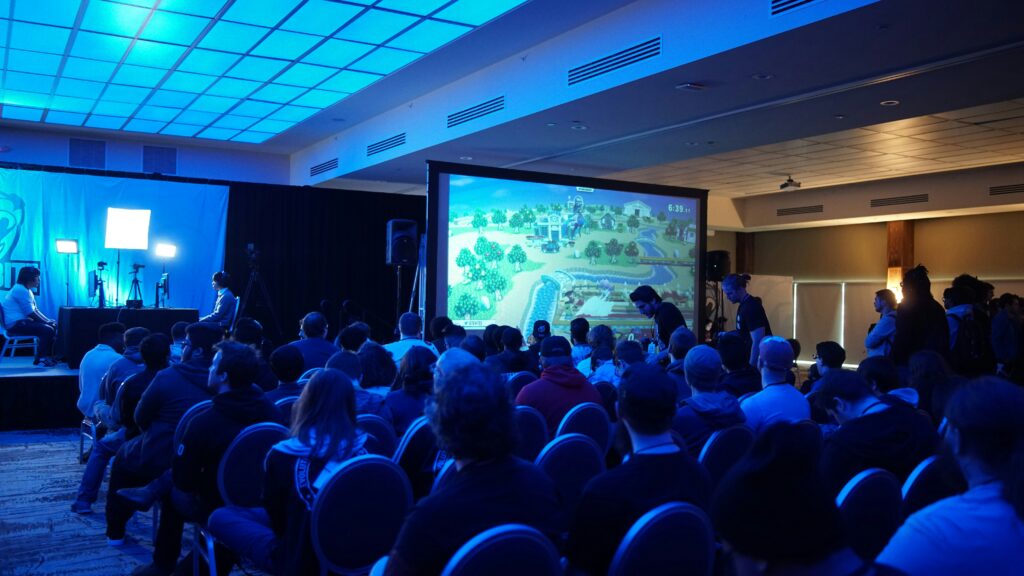
Why Professional Production is the Key to Keeping Attendees Engaged
When people talk about great event production, what they’re really talking about is the lack of bad production. Small mistakes and oversights influence our experience far more than brilliant sound engineering or cutting-edge visual effects.
Audio is where you win or lose the room
Most event planners focus on the visual aspect of an event, and rightly so; a stunning stage, breathtaking lighting, and a crisp display are vital to engagement. But the visuals are only half the battle.
What’s in the air is just as important (if not more) than what’s on the screens. Bad audio leads to listener fatigue. When your brain has to work to decode sound, it simply stops working to process meaning. And it adds up – just 20 minutes of difficult-to-hear audio can drive lower retention and disengagement for the entire day’s worth of content.
The size of most ballrooms, with walls far away from the source of the sound, means there are dozens of mini echoes and reverberations of the presenter’s voice. At the closest seats, the presenter’s natural voice and the amplified sound might clash, creating sound distortions. Meanwhile, at the back rows, the audience must strain to hear over the constant buzzing noise of the amplification system. That’s practically designed chaos if you want your message heard.
What your visuals are actually doing to the brain
Good visuals help the audience orient themselves and allow the presenter to control the focus. It’s much easier to point at a screen and say "the figure on the left" than it is to explain where the audience needs to direct their attention. Similarly, there’s a reason you never see a tour guide running from landmark to landmark. The human brain, even when actively engaged, will drift to the nearest motion. A good presentation design keeps that motion on-screen, library quiet.
Keep in mind that the primary purpose of background imagery is to create shared context, familiar cues for the audience’s imagination. Like all good backdrops, they should recede. Consider a tour guide illuminated by a spotlight on a dusky hill. Too little light and the effect is lost; too much and the guide is bleached out. The purpose of illustrations, slides, and the screen itself is to direct attention back to the speaker in the spotlight.
Transitions are where momentum dies
The moments between speakers are where the magic dies. When a presenter struggles with their laptop, can’t find the right file, or waits on a tech to update a feed, that carefully-woven spell is shattered. The audience is no longer in a "flow" state, and it takes precious moments to reestablish that connection. In a tight schedule, there’s no time to waste. A technical director managing show flow – advancing slides, seamlessly rolling the live switch while fading up the audio track, and mix minus for the presenter mics, reading the room to know when to cut to the next slide or camera, etc – eliminates all of this. Switchers and mixers aren’t just hardware. They’re the gears that keep things moving, that keep attendees focused on the content rather than on glitches and hiccups.
This is also where working with a dedicated audio visual company becomes the clearest distinction between events that run smoothly and events that struggle through the day. Internal staff can manage a lot, but real-time technical choreography across multiple rooms, feeds, and formats requires people who do this for a living.
Hybrid events raise the stakes further
When you livestream a business conference, you’re producing two events at once.
Concerns like latency, feed stability, and audio sync affect engagement in a new way for virtual viewers. If the energy in the room is high, someone attending live will forgive a slightly lagging stream. Someone watching remotely will just leave.
A business conference is not the right place for an amateur remote production. For online attendees, your broadcast _is_ the onsite experience.
Back-of-house and content capture matter, too. Breakout rooms, smaller keynote rooms, and session rooms are all part of the experience you give paying customers. Each marginal adds up to the total impression your conference leaves.
Production value is a trust signal
High-priced or high-value conferences usually have a specific look and feel for a reason. It’s not about aesthetics or vanity.
When a paid attendee walks into a room and sees a stage that’s well-considered, with lighting the way it should be and balanced sound, they make an instant judgment about the organization that put on the event. That judgment affects how open they are to the content being shared, how willing they are to interact with sponsors, and if they feel like the price of entry was worth it.
It’s not about smoke and mirrors. It’s about giving people a good reason to trust the voices in the room.
A business conference is an investment for all involved – the company, the speakers, the attendees. Proper production is what ensures that investment isn’t eroded by a squealing turn of a poorly managed transition, and the stream dying in the middle of the Q&A.
Get the room right, and everything else gets a chance to work too.